
WhatsApp Voice Notes After Hours: Transcribe, Reply, or Hand Off?
Voice notes are often the customer's easiest way to ask. A reliable after-hours workflow transcribes carefully, uses earlier chat context, and knows when to ask a person.
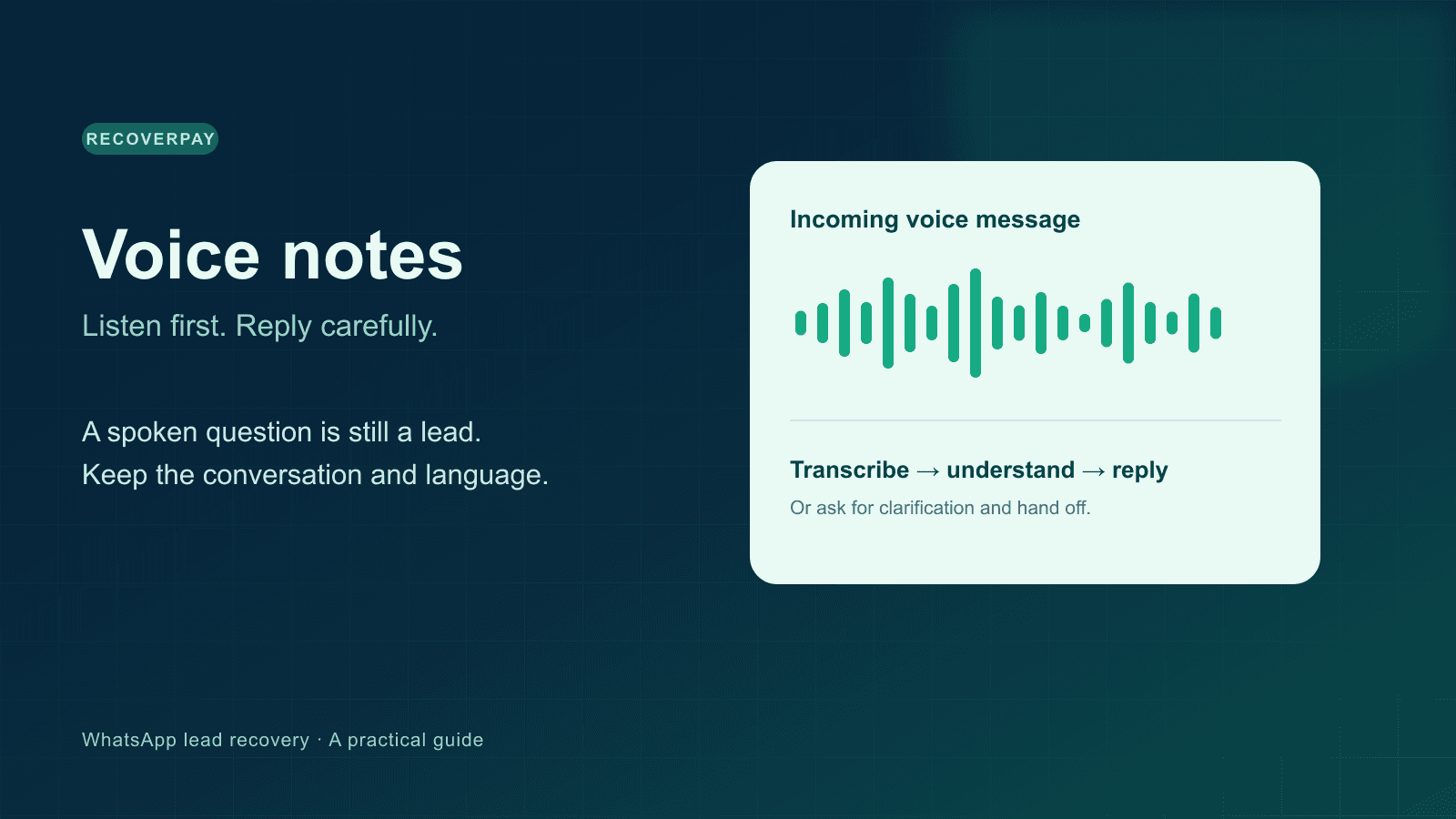
The shop closes at six. At 8:17 p.m., a customer sends a 20-second voice note asking whether the blue model can be delivered to Lahore. The last text in the chat mentioned a different model. A generic “we're closed” response misses the question; a confident “yes, tomorrow” can make a promise nobody checked.
The practical answer is to turn the voice note into usable conversation context, then decide whether the business can answer it safely. If the audio is unclear, ask for a shorter recording or text. If the customer wants a person, record that request. If a stock or delivery fact is unknown, leave it for the team.
What actually happens to a voice note
A sensible after-hours flow has five steps:
- Receive the inbound audio on the connected WhatsApp line.
- Attempt transcription with an audio-capable AI provider.
- Read the transcript alongside the earlier messages in that same conversation.
- Reply in the customer's language when the meaning is clear and the answer is supported.
- Ask for clarification or request a human handoff when the assistant cannot answer reliably.
This is more than converting speech to text. Consider “Is the blue one available?” The word one only makes sense if the system can see which product the customer and team discussed earlier. Even with context, it should not invent today's stock level.
A realistic example in Roman Urdu
The customer says: “Blue wala kal tak Lahore aa sakta hai?” A poor reply is: “Yes, it will arrive tomorrow.” Nothing in the question establishes inventory or delivery capacity.
A better reply is:
Aap blue model ki Lahore delivery ke baare mein pooch rahe hain. Main kal ki delivery confirm nahi kar sakta. Kya aap model ka naam ya photo bhej dein? Hamari team timing check karke isi chat mein jawab degi.
The exact language will vary. A Punjabi, Urdu, English, or mixed-language note can contain names, place names, and dialect words a model hears incorrectly. Have a person review consequential replies. Do not describe any language as perfectly supported without testing real recordings from your customers.
Where RecoverPay fits
RecoverPay's after-hours AI can work with an inbound voice message when the workspace has enabled AI replies and configured an audio-capable Gemini provider. It attempts transcription, keeps the detected language, and uses the conversation history for its answer. A failed or unintelligible transcription falls back to a clarification instead of guessing the audio. Provider availability and AI usage quota affect whether this path runs.
The current transcription path supports common audio formats and has a 12 MB audio limit. A file that cannot be read, exceeds that limit, or uses an unsupported format will not receive a normal transcript. The lead should still have a route to a person. For a plain text enquiry, see the after-hours auto-reply examples.
When someone explicitly asks for the owner or another human, the system can record a handoff request and send a truthful response: the person is unavailable right now, but the question remains in the chat. A human can then continue from the same thread. Notification delivery depends on the workspace preferences; it is worth testing before relying on it. This handoff explainer covers the team side.
Four guardrails before enabling audio replies
Do not manufacture a transcript. If a name, amount, or address is unclear, ask the sender to repeat it or type it. The model's confidence is not a substitute for a readable recording.
Do not confirm a transaction from inference. Stock, appointments, price changes, and delivery slots should come from current business records or a team member.
Respect the customer's choice of a person. A request to talk to the owner should stop the automated conversation from looping through more questions.
Check your channel rules. A reply to a recent inbound conversation differs from a new business-initiated message. If you use the official Meta API, follow the current WhatsApp Business Platform guidance on customer service windows and templates. A QR-linked session also needs connection monitoring.
Test with real speech, not a perfect studio recording
Use a few consented recordings with ordinary background noise and the languages your customers actually use. Include one message with an unclear product name, one with a mixed-language question, and one asking for the owner. Check the visible transcript, the reply, and the human handoff. Never use a customer's private recording as a public demo without permission.
Track three useful numbers: the share of notes with a readable transcript, the share that needed a person, and the number of replies a human had to correct. Those tell you whether the assistant is reducing work or creating another review queue. Search visibility may bring a visitor to the article; the experience must earn their trust after they message you.
Want to see it on your own line? Start a RecoverPay workspace, configure an audio-capable provider, and test a voice note from a second phone after the business closes.
Have questions about this article or your sales pipeline?
Ask us anything about automating WhatsApp follow-ups, re-engaging cold leads, or improving agent response times. Our team is here to help.